
FESTIVAL IZIS
DELAY
The 14th edition of Festival IZIS disrupts its usual festival form. The programme does not unfold in a concentrated format, but in three separate parts across the year, with intentional gaps between them.
This year’s IZIS approaches the temporalities of new technologies somewhat differently, as it questions and reflects on the delay by emphasizing lags, repetitions, echoes, loops, and resets within its own mechanisms and systems.
Details to follow. With delay.
Curator’s Statement
The 14th edition of the IZIS festival moves away from its usual compact format, unfolding instead across multiple temporal and spatial segments. The program intervals bring together exhibitions, artistic and musical performances, and workshops that engage with the notion of delay in all its complexity.
In our saturated techno-social reality, time both stretches and contracts: endless waiting can resemble relentless action. The relationship between past, present, and future further complicates spatiotemporal coordinates, making disorientation a modus operandi.
Disoriented, we press on because a world without progress is unimaginable. Disoriented, we follow the imperative of productivity. We hurtle toward a future that, under corporate capitalism, serves merely as a means to an end, already mortgaged in advance. Delay, in this sense, can be seen as a consequence of chronic exhaustion. Although exhaustion – as a sign of poor efficiency – carries negative connotations in Western culture, the philosopher Franco Berardi Bifo insists it must be recognized and embraced as a new paradigm of social life. In 2010, he wrote: “The coming European uprising will not be driven by energy, but by slowness, withdrawal, and exhaustion. It will be about the autonomy of the collective body and mind from exploitation through speed and competition.”
Delay can be seen as falling behind a faster-moving world, yet in a landscape of constant stimuli, delay is also a pause, a gap, a rest, a crack, a rupture. It opens a time of potential and anticipation, as well as a withdrawal from the predetermined paths of toxic hyperproductivity and a retreat from exploitation. By stretching their own temporality, workers reclaim their colonized time, which, in an era of perpetual extraction, has itself become a resource to be mined.
But how does delay operate within the measurable or mechanical time governed by clockwork mechanisms and the economic value of goods? How does it function within the lived temporality that resists calculation? As philosopher Henri-Louis Bergson notes, computational time belongs to mathematics and economics, yet society exists in the incalculable time of death as an end, not as a fate. Our perception of time is shaped by the finitude of life, and understanding real duration offers insight into experimentation with what contemporary, biotechnologically mediated bodies can become in relation to their environment. But how does delay alter this perception? What exactly is delayed – time, space, or the very perception of either?
This year’s IZIS approaches the temporalities of new technologies somewhat differently, interrogating and reflecting on delay by highlighting delays, repetitions, echoes, loops, and resets within its own mechanisms and systems. It explores the notion of delay as a potential strategy of resistance against the relentless imperative of hyperproductivity, while presenting diverse artistic positions that foreground aspects of technological temporalities from the perspectives of environmental processes, human experience, and the mechanical gaze of the machine.
- Irena Borić, curator of IZIS
PROGRAM
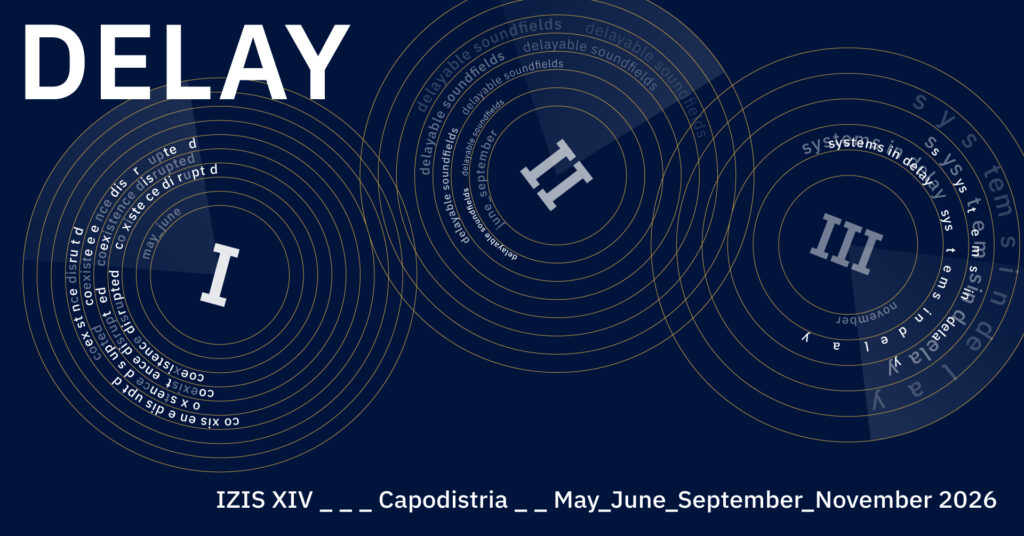
DELAY I_Coexistence Disrupted__Student Programme_May_June_2026
An exhibition by second-year Visual Arts and Design students, University of Primorska Faculty of Education
Gravisi-Buttorai Palace, Ulica Osvobodilne fronte 8, Koper
Opening: 28 May 2026, 18:30
28 May – 10 June 2026
DELAY II_ DelayAble Soundfields_Sound_Music Programme__June_September_2026
Bastion, Koper
21 September 2026, 20:00 Karmen Ponikvar, IMMERSIVE LIVE SOUND PERFORMANCE Electronics, field recordings, performance on DodekaOTTO
22 September 2026, 20:00 Concepción Huerta EL SOL DE LOS MUERTOS (SUN OF THE DEAD) Electroacoustic composition, live tape processing, 3D audio performance
19 June 2026, 20:00 DREAMSPACES: Antonio Della Marina & Alessandra Zucchi Saxophone, electronics / live video projections__Duration: 45–55 min
23 June 2026, 20:00 UNDULATING WAVES: Tilen Lebar, Maria Nikolić & Mauricio Valdés San Emeterio Composition, saxophones, field recordings / english horn, oboe / live electronics__Duration: 60 min
DELAY III_Systems in Delay_Main Exhibition_November_2026
Libertas, Koper
6 – 22 November 2026
Programme to follow — with delay.
The IZIS XIV Festival is supported by: PiNA, HEKA, Stran22, Mestna občina Koper, Zavod za mladino, kulturo in turizem Koper, Ministrstvo za kulturo, JSKD, Obalne Galerije Piran, Skupnost Italijanov “Santorio Santorio” Koper – Comunità degli Italiani “Santorio Santorio” di Capodistria, Univerza na Primorskem (Pedagoška fakulteta – Vizualne umetnosti in oblikovanje) in Prohelvetia.